When you decide to buy an off-road vehicle, one of the first questions that comes up is: should you choose an ATV or a UTV? Both types of vehicles have their pros and cons, and the right choice depends on how you plan to use them.
In this guide, we compare ATV and UTV vehicles in detail across all key features. Whether you're looking for a vehicle for recreation, hunting, agriculture, or work, this article will help you make a decision.

What is an ATV?
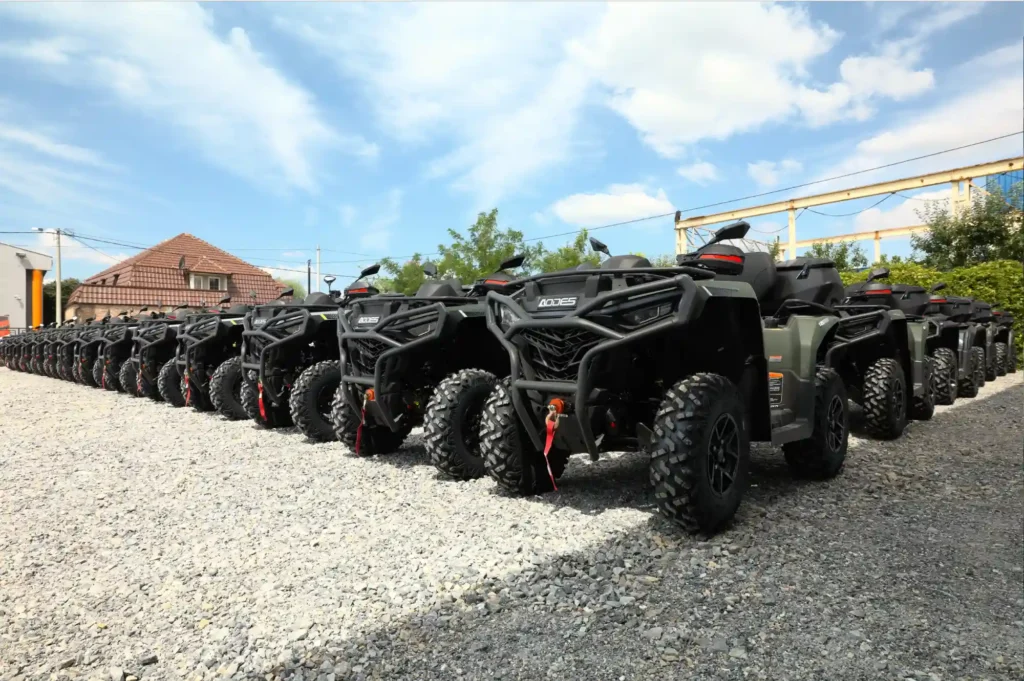
ATV is an acronym for All-Terrain Vehicle. In everyday speech, an ATV is most often called a quad or quadricycle. It is a four-wheeled vehicle that is steered with a handlebar, similar to a motorcycle.
ATVs are compact, nimble, and designed for a single rider, although some models have room for one passenger. The rider sits on the vehicle and actively participates in steering by shifting their body weight, especially in turns and over uneven terrain.
Typical characteristics of ATV vehicles
Engine Displacement: The ODES Pathcross series offers models from 495 cc (Pathcross 525 Standard / LUX) to 976 cc (Pathcross 1000 MAX PRO and 1000 MUD PRO), with power ranging from 28 kW to 63.7 kW.
Weight: From 365 kg (Pathcross 525 LUX) to 420 kg (Pathcross 1000 models) for an empty vehicle, making them relatively easy to transport and maneuver.
Width: From 117 cm (Pathcross 525 LUX) to 125 cm (Pathcross 650, 850, 1000 models), allowing passage through narrow trails and forest paths.
Drivetrain: All ODES ATV models have a selectable 2WD/4WD drivetrain with a cardan shaft. with the ability to lock the front differential.
What is a UTV vehicle?
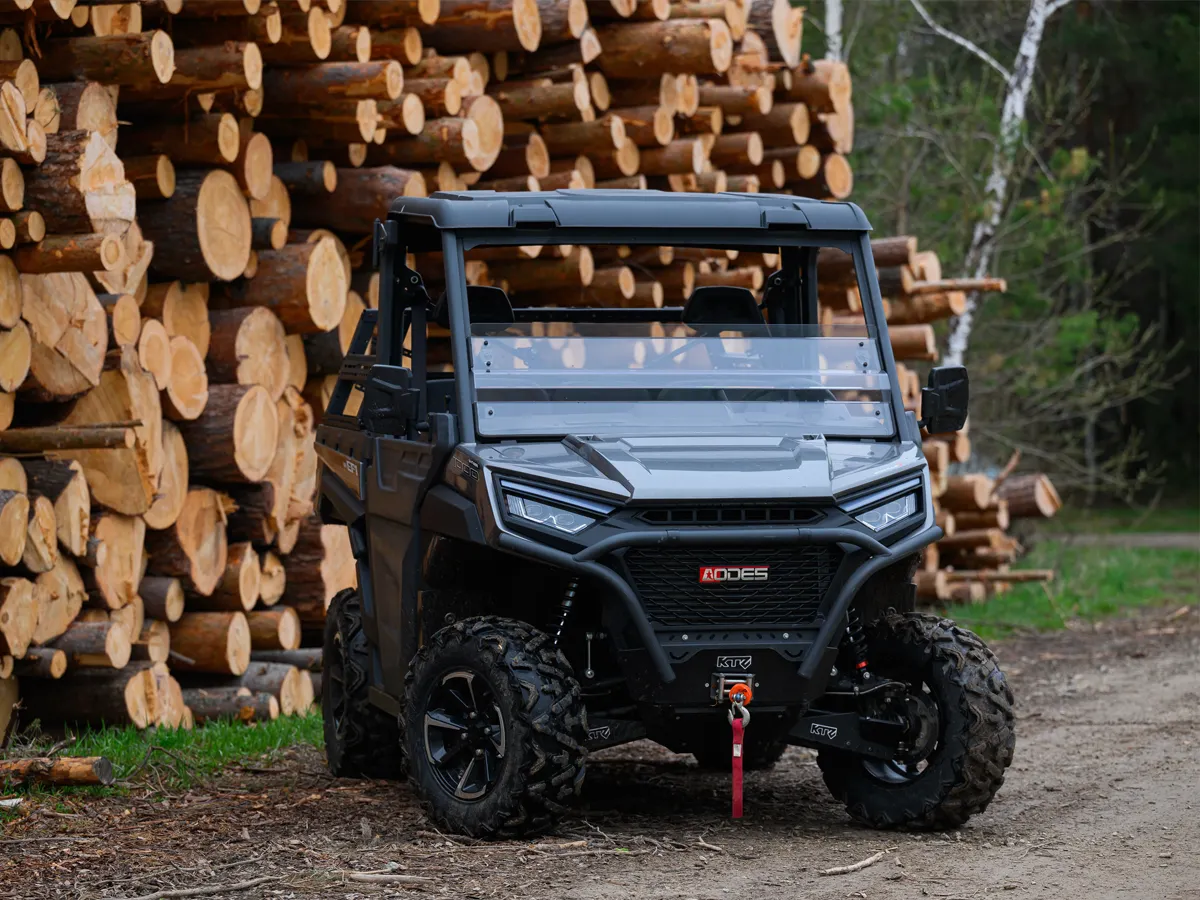
UTV is an acronym for Utility Task Vehicle, and it is often called a side-by-side (SxS) because of the seating arrangement where the driver and passenger sit side-by-side. Unlike an ATV, a UTV is steered with a steering wheel, has a gas pedal and brakes like a car, and usually has an enclosed cab.
UTV vehicles are larger, heavier, and can carry more people, from 2 to 6 depending on the model. They are designed for heavy-duty work, material transport, and group activities.
Typical characteristics of UTV vehicles
Engine displacement: The ODES Workcross series offers models with 649 cc (Workcross 650 V-Twin, 35 kW) and 976 cc (Workcross 1000 X6 HVAC, 53 kW) engines.
Weight: From 380 kg (Workcross 650 V-Twin) to 1,040 kg (Workcross 1000 X6 HVAC) unladen weight, significantly heavier than an ATV.
Width: 165 cm on both Workcross models, which limits passability on narrower trails.
Capacity: The Workcross 650 V-Twin accommodates 3 passengers with a cargo capacity of 454 kg. The Workcross 1000 X6 HVAC accommodates up to 6 passengers and has a large cargo area.
Cabin: Both models have a roll cage and the option to install a windshield, roof, and doors. The Workcross 1000 X6 HVAC comes with an HVAC system (heating and cooling), power windows, a parking camera, radio, and Bluetooth connectivity for maximum comfort and functionality.
Direct Comparison: ATV vs UTV
To make your decision easier, we have prepared a detailed table comparing the key characteristics of both types of vehicles based on the ODES Pathcross and Workcross models:
Characteristic | ATV (Quad) | UTV (Side-by-Side) |
Number of passengers | 1-2 | 2-6 |
Management | Korman (as an engine) | Steering wheel (like a car) |
Vehicle width | 117-125 cm | 165 cm |
Weight (empty) | 365-420 kg | 380-1.040 kg |
Total weight | 410-500 kg | 835-1.618 kg |
Cargo capacity | 15-30 kg | Up to 454 kg |
Engine displacement | 495-976 cc | 649-976 cc |
Engine power | 28-63.7 kW | 35-53 kW |
Plant | 2WD/4WD, driveshaft | 2WD/4WD, driveshaft |
Protected cabin | No | Yes (optional) |
Agility | Excellent | Limited |
As you can see from the table, ATVs and UTVs have differences. The ATV is more compact and maneuverable, while the UTV offers greater capacity and comfort.
Advantages of ATVs
ATV vehicles have several key advantages that make them an ideal choice for certain purposes:
1. Agility and maneuverability
Thanks to its narrower width (only 117-125 cm) and weight, the ATV can get through narrow forest trails, between trees, and over terrain where a UTV simply can't fit. This is especially important for hunters and forestry workers who travel on unpaved roads.
2. Easier transport
An ATV can fit in most pickup trucks or on a small trailer. Weighing 365-420 kg, it is significantly easier to transport than UTV models that weigh up to 1,040 kg.
3. Lower price
Generally, ATVs are more affordable than UTV models of similar displacement. The price difference can be as much as 50%, which is a significant factor for many buyers.
4. Professional Maintenance at the ODES Service
All maintenance is performed at the ODES authorized service center, where trained technicians guarantee the proper operation of your vehicle.
5. Active driving experience
For many riders, the very act of actively balancing and maneuvering the ATV is part of the enjoyment of riding.
Benefits of UTV vehicles
On the other hand, UTVs offer advantages that ATVs cannot provide:
Capacity for more passengers
If you want to ride with your family or a group of friends, a UTV is the only option. The ODES Workcross 650 V-Twin seats 3 passengers, while the Workcross 1000 X6 HVAC offers as many as 6 seats for group outings and adventures.
2. Greater cargo capacity
UTV vehicles have significantly more cargo space. The Workcross 650 V-Twin has a cargo capacity of 454 kg with a hydraulic lift, making it ideal for agriculture, construction, and any job that requires hauling materials.
3. Comfort and protection
The cab, with a roof, windshield, and doors, provides protection from rain, wind, and dust. The Workcross 1000 X6 HVAC goes a step further with a heating and cooling air conditioning system, which is ideal for long workdays in the field.
4. Easier management for beginners
Operating the handlebars and pedals is more intuitive for people who come from cars. There's no need to learn balancing like with an ATV.
5. Safety features
A roll cage, safety harnesses, and a more stable construction make the UTV safer, especially on steep terrain and at higher speeds.
Which type of vehicle to choose?
Now that you know the differences, it's time to determine which type of vehicle suits your needs. Here are some guidelines based on typical uses:
Choose an ATV if:
You plan to ride solo or with one passenger. You need maximum maneuverability for tight trails and forest roads. You have a limited budget. You want a vehicle that is easy to transport. You enjoy an active riding style.
Choose a UTV if:
You want to drive with your family or a group. You need a large cargo capacity for work. Comfort and weather protection are your priorities. You plan for long workdays in the field. You want easy, car-like handling.
ODES recommendations
ODES offers a complete line of ATVs through the Pathcross series: the Pathcross 525 LUX (495 cc, 28 kW) for lighter recreational use, the Pathcross 650 V-Twin (649 cc, 39.5 kW) as a versatile model, Pathcross 850 MAX (800 cc, 44 kW) for more demanding terrain, and the Pathcross 1000 MAX PRO and 1000 MUD PRO (976 cc, 63.7 kW) for professional use and the toughest conditions.
For the UTV category, ODES offers the Workcross 650 V-Twin (649 cc, 35 kW, 3 seats) for work and adventure, the Workcross 1000 X6 HVAC (976 cc, 53 kW, 6 seats) and the Workcross 1000 X3 HVAC (976 cc, 53 kW, 3 seats) with air conditioning for maximum comfort.
Practical tips before buying
Before you make a final decision, consider the following factors:
Test before purchase
Nothing can replace a personal experience. Schedule an ATV test drive with an ODES authorized dealer to experience the quality of handling and performance on the trail.
Consider the terrain
Where will you be riding most often? If your trails are narrow and winding, an ATV is a better choice. If you have wider roads and open terrain, a UTV may be more practical.
Plan for the future
How will your needs change? If you're planning a family or expanding your business, it might be better to invest in a UTV right away.
Include the total costs
In addition to the vehicle price, include the costs of transportation (do you need a larger trailer?), maintenance at an ODES authorized service center, fuel, and insurance.
Frequently Asked Questions (FAQ)
P: Is an ATV or a UTV safer?
O: A UTV is generally considered safer due to its roll cage construction, seat belts, and more stable platform. However, proper training and wearing protective gear are key to safety on both types of vehicles.
Q: How much does it cost to maintain an ATV compared to a UTV?
ATV vehicles have lower maintenance costs due to their simpler construction and fewer parts. All maintenance is performed at an ODES authorized service center, where trained technicians use original parts and guarantee the proper functioning of your vehicle. Contact us for a detailed service price list.
Which type is better for hunting?
For individual hunters, an ATV is usually a better choice due to its maneuverability and ability to navigate narrow trails. For hunting groups or game wardens, a UTV may be more practical due to its capacity for more people and equipment.
Q: Where is maintenance performed on ATV and UTV vehicles?
All maintenance and service interventions are performed exclusively at an ODES authorized service center. Trained technicians use original parts and guarantee the proper operation of your vehicle.
Conclusion
The choice between an ATV and a UTV depends entirely on your needs and how you plan to use it. An ATV is ideal for those seeking agility, affordability, and an active riding experience. The ODES Pathcross series offers models from 495 cc to 976 cc for every purpose. A UTV is a better choice for families, groups, and users who need greater capacity and comfort. ODES Workcross models offer 3 to 6 seats with a payload capacity of up to 454 kg.
Regardless of which model you choose, ODES offers quality vehicles with proven reliability and the support of an authorized service center in Serbia. Visit our showroom and speak with our experts about which vehicle best suits your needs.
SCHEDULE A TEST DRIVE: (060) 611 63 40 | office@odes.rs